We replace and install heat energy meters, and we arrange their verification at an accredited laboratory. We work with apartments, houses and property managers.
A water meter measures one quantity — the volume of water that has passed through it. A heat meter measures heat energy, and that cannot be done with a single sensor. It needs a flow meter and two temperature sensors: one on the flow pipe, the other on the return. The meter calculates the energy used from the flow rate and from the temperature difference between the two pipes.
In practice this means two things. First, there are more places where installation can go wrong — a sensor fitted in the wrong position or the wrong order changes the result. Second, a fault is not always obvious: the meter can look as though it is working while reading inaccurately, if one of the sensors is damaged.
That is exactly why a site visit before the work matters even more with heat meters than with water meters. We assess not only the meter itself, but also the sensors, where they are fitted and the condition of the assembly as a whole.
Removing the old heat meter and installing a new one together with its temperature sensors.
Removing the meter, taking it to an accredited laboratory and installing it again.
Setting up heat energy metering at properties that do not have it yet.
Work on the building's main heat meter and on sites with several metering points.
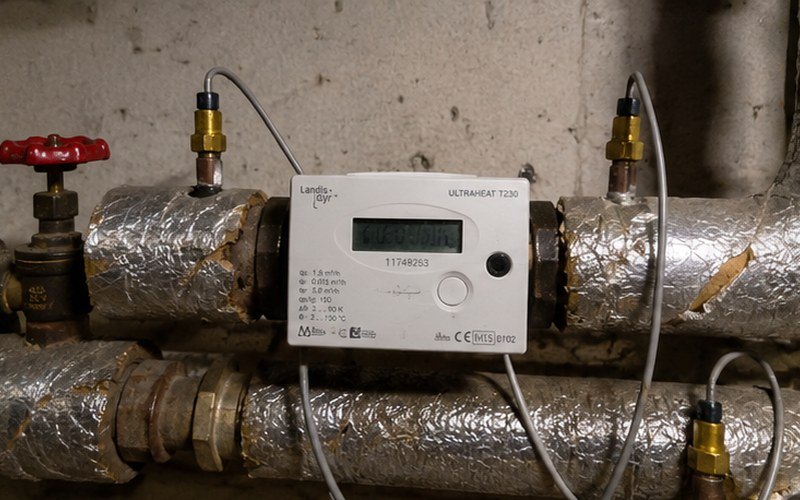
As with water meters, the choice is not the same in every case. The difference here is that a heat meter has more parts, and they can age separately. The measuring unit may be in working order while the temperature sensors are worn out, or the other way round.
In practice this means verification makes sense when the device as a whole is in good condition and relatively new. If the meter's electronics are dated or the sensors are damaged, verification often costs almost as much as installing a new meter, and you are still left with the old device.
We assess this during the site visit and tell you what we think. If we believe verification is enough in your case, we will say so — even if a replacement would earn us more.
Heat meter work differs from water meter work in that it is distinctly seasonal. Outside the heating season the system is neither pressurised nor hot, so the work is simpler, safer and disturbs no one.
The work can also be done during the heating season, but then it needs coordination — particularly in apartment buildings, where the heat supply has to be shut off for a riser or for the whole building. If you are planning to sort out a heat meter, summer and early autumn are usually the most convenient time.
That is precisely why we advise property managers to plan this work in advance, rather than waiting until the season has already started and the problem has become urgent.
Apartment owners. Some apartment buildings have individual heat meters in the apartments. They need to be maintained just like water meters, and it is usually the owner who looks after them.
Private house owners. In houses with district heating or a separate heating unit, the meter is part of the system, and its condition affects how accurate your bill is.
Property managers and companies. The building's main heat meter is the one used to calculate consumption for the whole building. For sites with several metering points we plan the work after a survey — more in the section on working with property managers.
If your building also uses heat cost allocators on the radiators, we cover those separately — see the section on heat cost allocators.
We will get in touch within 5 minutes of you submitting the form
Your request has been received. We will contact you as soon as possible.