We supply and install smart, electronic and ultrasonic water meters. First we assess whether they are justified at your property.
A mechanical water meter works with a rotor: the flow of water turns it, and a gear train transfers the movement to the dial. This design is simple and reliable, but it has two limitations. Moving parts wear out, and at very low flow rates the rotor may not turn at all — an old mechanical meter often fails to register a thin stream or a slow drip.
An electronic meter measures differently. An ultrasonic meter has no moving parts at all: the measurement is made by comparing how long a sound signal takes to travel with the flow and against it. That means less wear and better sensitivity at low flow rates.
The other feature — remote reading — is separate from the measuring principle. A meter can be ultrasonic without remote reading, and the other way round. We write about the reading side in more detail in the section on remote meter reading.
We look at the meter assembly and tell you whether a smart meter will bring a real benefit in your situation.
We select and deliver a device that suits the system — you do not need to buy anything.
Fitting, a working check and, as agreed, sealing with the accompanying documents.
Replacing a mechanical meter with an electronic one, where that is justified.
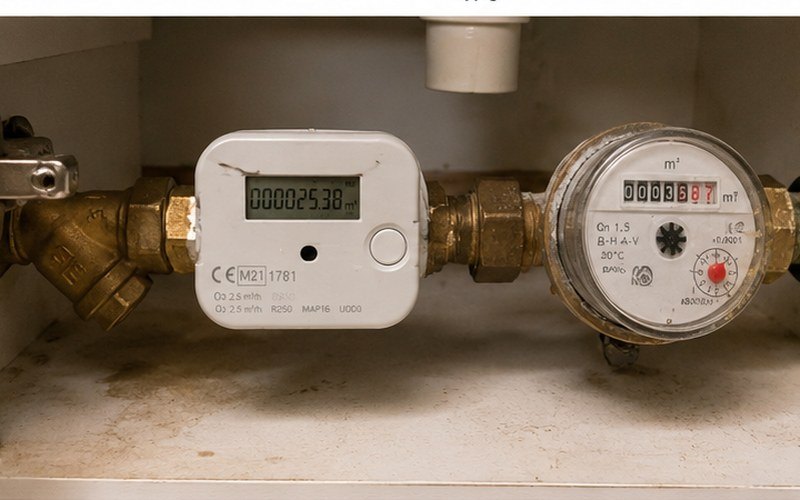
The honest answer is that it is not for everyone. A smart meter costs more than a mechanical one, and the benefit depends on how metering works in your building.
It is usually justified when a building is moving to unified remote reading, when submitting readings is a recurring problem, when a property has many metering points, or when the meter sits somewhere hard to reach and manual reading is awkward.
It is less justified in an apartment where submitting readings is no trouble and where the building has no system that could receive remote readings. In that case you are paying for a feature that goes unused.
During the site visit we weigh up the situation and give you a recommendation. If we think a good mechanical meter is enough in your case, we will say so.
Terms overlap in the meter market, and that makes comparison harder. "Smart", "electronic", "ultrasonic" and "remotely readable" are not synonyms — they describe different properties that may, but need not, come together in a single device.
In practice three questions determine the choice. First — how the instrument measures: mechanically or electronically. Second — whether and how it passes the reading on. Third — whether the device you choose is compatible with what already runs in your building, or with what is being planned.
It is the third question that most often goes unasked, and it is the one that causes disappointment. A device can be technically good, but if it does not talk to the building's reading system, its main advantage goes unused. So we establish this before installation, not after.
At building scale, smart meters make sense when they are part of a system rather than isolated devices. If remotely readable meters are installed in every apartment in a building, the readings are all taken at the same moment — and that resolves one of the most common causes of metering disputes, namely that different apartments submit their readings on different dates.
In a project like this the most important thing is not the device but the organisation: the schedule, resident notifications and documentation for each apartment. How we organise that is described in the section on working with property managers.
If you are not yet sure whether you need a straightforward replacement or a move to a smart meter, note in your request that you would like advice — we will work it out together.
We will get in touch within 5 minutes of you submitting the form
Your request has been received. We will contact you as soon as possible.