In Riga the water metering situation varies with the age of the building far more than with the district. We work in every neighbourhood of Riga — from new developments in Vecrīga to Soviet-era housing estates.
Riga is not one market but several. Replacing a water meter in a wooden house in Āgenskalns, in a 1970s nine-storey block in Purvciems and in a new development in Skanste are three different jobs, even though the service goes by the same name. The difference comes not from the address but from the period the building was put up in and how its plumbing was arranged.
In practice this means that before the job it matters more to us to know the type of building and where the meters sit than which district you are in. That is exactly why the request form asks about the type of property — the answer changes both how we prepare and how much time we set aside for the work.
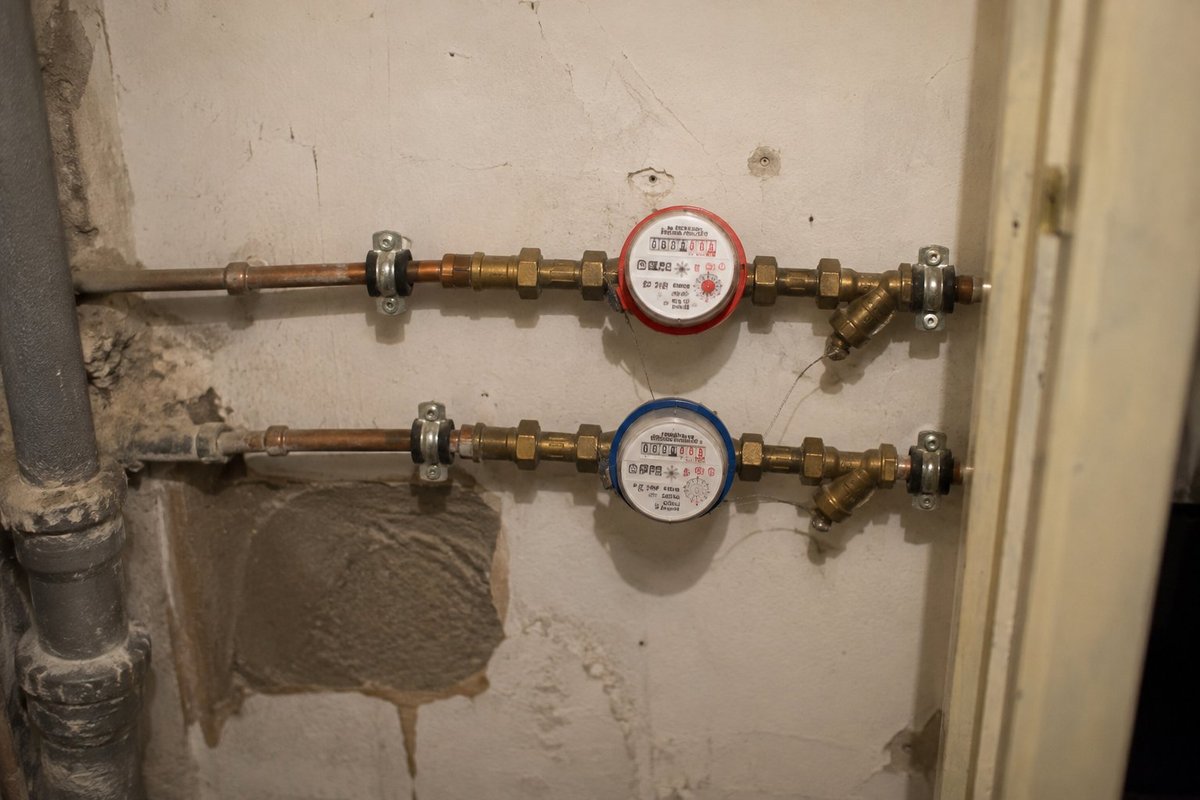
Soviet-era housing estates. In Purvciems, Pļavnieki, Ķengarags, Imanta and Zolitūde the meters are almost always in the bathroom or the toilet next to the riser, often behind an inspection hatch. The advantage of these buildings is predictability: a standard design means the assembly looks similar in every apartment. The most common problem is not the meter but the shut-off valve, which has not been turned since the building was handed over.
Pre-war and inter-war buildings. In the centre, Āgenskalns and Grīziņkalns the plumbing has often been rebuilt several times, and two apartments in the same building can be completely different. Here it is almost always worth starting with a survey — a quote given over the phone tends not to match reality in buildings like these.
New developments. In Skanste, Teika and other newer buildings the assemblies are usually tidy and accessible, but they may sit behind built-in panels or be split across several points. Newer buildings are also more likely to have more than two meters in a single apartment.
Detached-house neighbourhoods. In Mežaparks, Bieriņi, Berģi and Vecāķi the meter situation is closer to the private-house scenario than to an apartment: the assembly may be in a basement, a utility room or a well outside the building.
Apartment owners in the housing estates. Most requests come from apartments in Purvciems, Pļavnieki, Ķengarags, Imanta and Zolitūde, where the meters were fitted at roughly the same time and are nearing the end of their service life.
Owners in the centre and older buildings. Here the reason for getting in touch is more often a specific problem — damp around the connections, a fogged-up dial or a broken seal — rather than a planned replacement.
Residents of new developments. In new buildings the question is usually about an additional metering point, or about whether the existing metering matches actual usage.
Property managers and building management companies. Building-wide projects, where what matters most is the schedule, informing residents and consistent documentation.
In Riga we offer the full range of services, and each of them includes selecting and delivering the meter — you do not need to know your way around models or drive to a shop.
For properties with no metering, or where an additional metering point is needed — in Riga most often in new developments and detached houses.
The seal and the certificate — property managers in Riga ask for them almost every time.
You fill in the form, giving the type of building and the number of meters. In Riga the type of building tells us more than the district does.
We reply to your request and agree a time. In Riga we plan our visits district by district, so we can usually offer you several options.
We shut off the water supply to your apartment and replace the meter. The other apartments are not affected.
We seal the meter and prepare the certificate with the readings — property managers in Riga ask for it almost every time.
In Riga apartments the biggest waste of time is a meter assembly that has been boxed in or buried behind clutter. If the meters are in a cupboard under the sink or behind an inspection hatch, it is worth clearing access beforehand. The other thing worth knowing is where the water shut-off valve is — in many buildings it is right next to the meters, but in older stock it can be elsewhere. If the valve does not work, it is worth saying so in your request, because then the job has to be planned differently.
In Riga the most common reason a job takes longer than planned is not the meter itself but getting to it. During renovations the assemblies often end up boxed in behind tiles or hidden by furniture, and the inspection hatch is sometimes smaller than it needs to be. If you know access is tight, tell us in your request — there is usually a solution, we just need to know in advance.
The second typical Riga situation is apartments that are let out. The meter belongs to the apartment, so the decision to replace it is normally the owner's, even if the tenant is the one arranging the work in practice. It is worth settling this before you send the request, so that questions about who ordered the work and who is paying for it do not come up later.
The third point concerns buildings where the property manager is organising a centralised replacement. If one has been announced for your building, it may well be worth waiting for it — done across the whole building, the work often costs less than an individual call-out. If you are not sure, ask your property manager before ordering the work separately.
In Riga we also work with property managers and building management companies that need the meters replaced throughout a building. In an apartment block with a hundred apartments the work is no longer a technical task but a project, with a schedule, resident notifications and documentation. How we run building-wide projects is described in the section for property managers.
Besides Riga we also work in the surrounding areas. Distances are straight-line and approximate.
| Type | state city and capital of Latvia |
| Municipality | City of Riga municipality |
| Region | Riga region |
We work throughout Riga. For 20 neighbourhoods we have prepared a separate page describing what affects water meter work in that particular place — the typical building stock, where the meters usually sit and what kinds of properties we most often work with there. Those are highlighted with a link.
The remaining neighbourhoods are listed alongside them. The fact that a neighbourhood has no page of its own does not mean we do not work there — its building stock simply does not differ enough to be worth writing about separately. Give us the address in your request and we will get back to you.
Avoti · Berģi · Brasas · Brekši · Bukulti · Centrs · Dreiliņi · Dārzciems · Dārziņi · Grīziņkalns · Jugla · Maskavas forštate · Mežciems · Purvciems · Pļavnieki · Rumbula · Teika · Vecrīga · Ķengarags · Šķirotava
Aplokciems · Jaunciems · Jaunmīlgrāvis · Kundziņsala · Mangaļi · Mangaļsala · Mežaparks · Sarkandaugava · Suži · Trīsciems · Vecdaugava · Vecmīlgrāvis · Vecāķi · Čiekurkalns
Atgāzene · Beberbeķi · Bieriņi · Bišumuiža · Bolderāja · Daugavgrīva · Dzirciems · Imanta · Iļģuciems · Katlakalns · Kleisti · Klīversala · Lucavsala · Spilve · Torņakalns · Voleri · Zasulauks · Zaķusala · Ziepniekkalns · Zolitūde · Āgenskalns · Ķīpsala · Šampēteris
Krasta rajons
58 Riga neighbourhoods in total. The list is for navigation — it does not mean we have an office or a permanent team in each of them. We work on a call-out basis.
We will get in touch within 5 minutes of you submitting the form
Your request has been received. We will contact you as soon as possible.